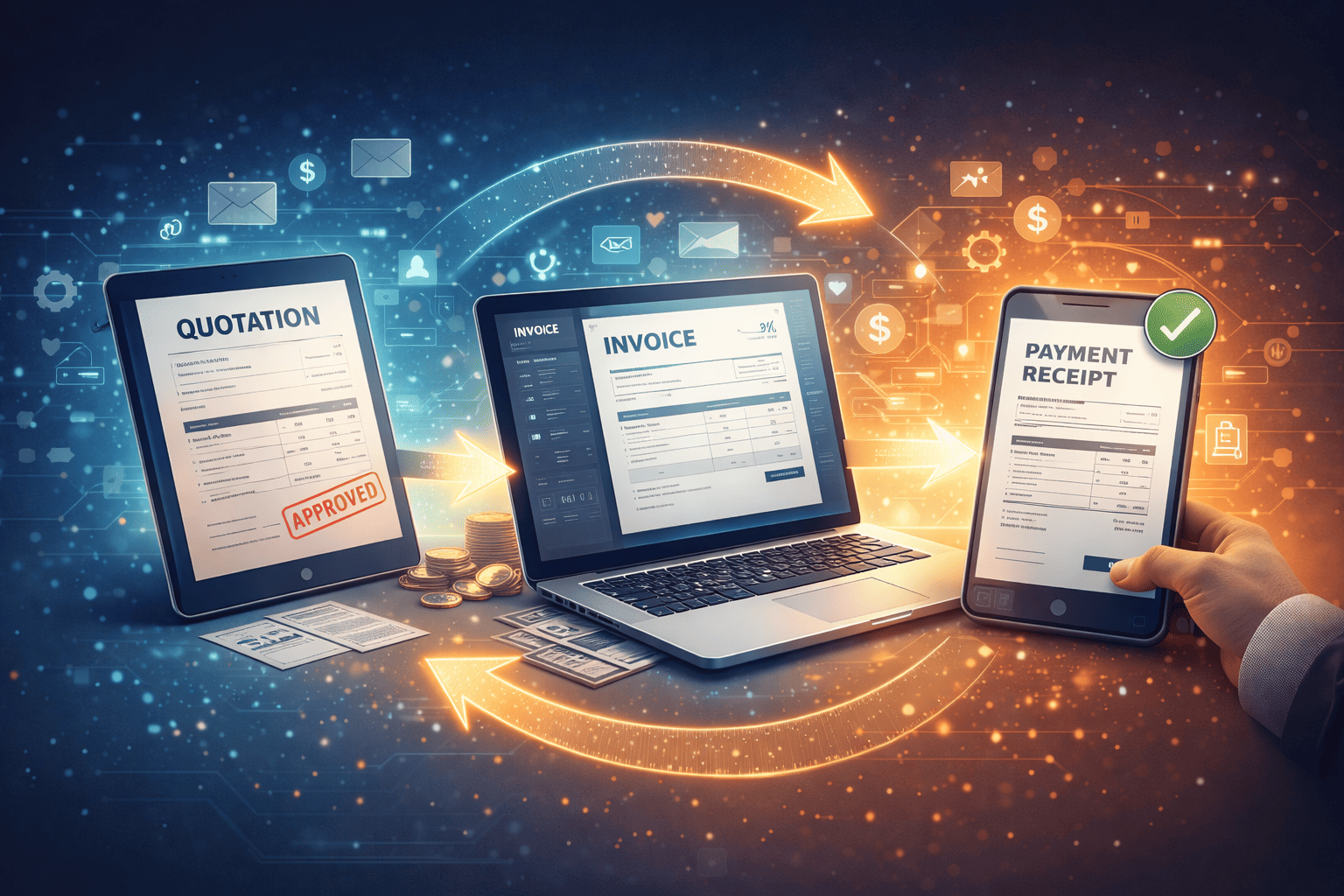
Mastering the Financial Document Cycle
For any business, maintaining healthy cash flow and accurate records hinges on a seamless flow of financial documentation. The complete financial document cycle, spanning from the initial customer inquiry to the final receipt, is a critical operational process. Understanding and optimizing this cycle not only ensures compliance but also accelerates payment times and reduces administrative overhead.
Phase 1: Initiation – Quotation and Proposal
The cycle begins with the customer’s request. Your response is the Quotation or Estimate. This document details the products, services, costs, terms, and delivery schedules. It is a non-binding offer, setting expectations for the transaction. If the customer agrees, the quotation transforms into a formalized commitment. In B2B environments, this commitment often takes the form of a Sales Order or a Purchase Order (PO) issued by the buyer, which legally binds both parties to the agreed-upon terms and prices.
Phase 2: Execution – Invoicing and Tracking
Once the goods or services have been delivered, the process moves to billing. The Invoice is the official demand for payment. A high-quality invoice must clearly reference the original sales order or PO number, detail the items delivered, the total amount due, payment terms (e.g., Net 30), and the due date. Timely and accurate invoicing is crucial for minimizing Days Sales Outstanding (DSO).
During this phase, robust document management is essential. Businesses must meticulously track outstanding invoices, often utilizing accounts receivable software. Automated reminders and clear internal processes prevent invoices from slipping through the cracks, a common source of cash flow problems. This tracking ensures that the financial document cycle remains on schedule.
Phase 3: Completion – Payment and Receipt Generation
The cycle reaches its conclusion upon payment. As soon as funds are received—whether via bank transfer, credit card, or check—they must be accurately reconciled against the open invoice. The final step is issuing the Receipt. The receipt is proof that the debt has been fully settled and officially closes the transaction in the financial records.
A proper receipt should include the date of payment, method of payment, amount received, and a reference to the original invoice number. Electronically generated receipts are now standard practice, offering instant delivery and further bolstering the efficiency of the financial document cycle.
Optimizing Your Workflow
To truly master the financial document cycle, businesses should focus on automation. Implementing integrated Enterprise Resource Planning (ERP) or accounting systems allows documents to seamlessly flow from one stage to the next—converting a quotation directly into an invoice and then generating a receipt upon payment recording. This integration minimizes manual entry errors, accelerates processing speed, and provides real-time visibility into the health of your accounts receivable, ensuring optimal performance from quotation to final receipt.